From 17+ years of hands-on engineering · 7 min read
Modernizing a Legacy PHP Application Without a Full Rewrite
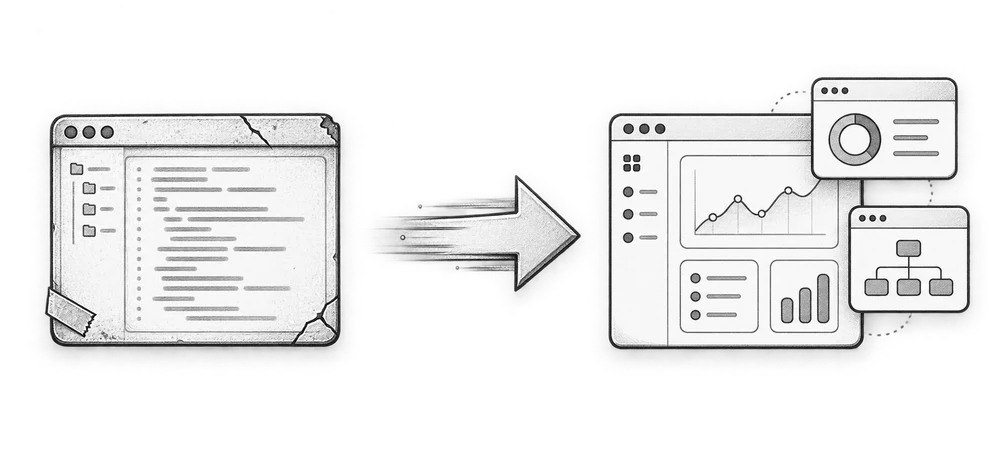
I have worked with PHP applications that have been running for years, earning money and supporting daily operations while becoming increasingly difficult to change. In that situation, the first question is rarely ‘Which framework should replace this?’ The useful question is ‘How do we make the next important change safer without putting the business at risk?’
In this guide
- 1Old code is not automatically bad code
- 2Start with the workflows the business cannot afford to lose
- 3Check the live app before planning major changes
- 4Create one safe boundary at a time
- 5Upgrade the platform in a practical order
- 6Use Symfony where it earns its place
- 7Keep database changes boring and reversible
- 8Measure modernization by business confidence
Old code is not automatically bad code
An older application often contains years of business knowledge. Some of that knowledge may be badly organized, but it is still real: unusual pricing rules, customer exceptions, reporting logic, imports, scheduled jobs, and integrations that people depend on. A rewrite can accidentally remove those details because nobody remembers to include them in the new specification.
I do not judge a system only by its folder names or framework version. I first look at what the app does for the business, where changes become slow and which failures would hurt customers. Old but stable code may need less attention than a newer part that loses orders or exposes data.
Start with the workflows the business cannot afford to lose
Before changing architecture, I map the few workflows that matter most. In an online business this might be registration, checkout, subscription renewal, fulfilment, a customer portal, or an internal process that keeps operations moving. These are the places where a small mistake has a real cost.
This turns a broad update project into a short list of priorities. We are no longer trying to ‘clean up the whole application.’ We are protecting the parts that make money, affect customer trust or take the most staff time.
- Which actions directly create or protect revenue?
- Which failures cause customer complaints or manual recovery?
- Which areas are changed frequently but are difficult to test?
- Which integrations would stop the business if they failed?
Check the live app before planning major changes
The code rarely tells the whole story. I also check live errors, slow requests, database load, scheduled tasks, release steps, server settings and support problems. This often shows that a few main issues are causing most of the trouble.
For example, a website may feel slow because of one report, one database query or one outside request. Rebuilding other screens would cost money without fixing the delay. Better error reporting can also make the app easier to support before any large code change begins.
The review should explain in plain English what is risky, what is simply messy and what can wait. A business owner should understand why each suggested change matters.
Create one safe boundary at a time
Older PHP applications often mix page rendering, database queries, validation, permissions, and business rules in the same files. Trying to separate everything at once creates a long project with little visible value. I prefer to create a boundary around one important responsibility and then improve what sits behind it.
A payment calculation, document workflow, notification process, or customer-import routine can be moved behind a clear service without replacing the rest of the application. The existing screens continue to work, while new tests and logging make that specific responsibility safer to change.
Once one part has been cleaned up this way, the team has a pattern it can reuse. The old app improves through small, safe changes instead of being replaced by a second app.
- Capture current behaviour with focused tests before changing it
- Separate business decisions from controllers and templates
- Wrap payment, email, storage, and external APIs behind clear interfaces
- Add useful logs around failures and important state changes
Upgrade the platform in a practical order
PHP, database, operating-system, and dependency upgrades matter because unsupported software becomes a security and maintenance risk. But upgrades need sequencing. Jumping several major versions while changing architecture and user-facing behaviour makes problems difficult to isolate.
I normally separate compatibility work from business changes wherever possible. First we make the current behaviour visible, remove or replace dependencies that block the upgrade, and establish a repeatable test and deployment path. Then we move through supported versions in steps that can be verified and released.
The business benefit is not the version number itself. It is the ability to receive security fixes, hire people who can work confidently in the codebase, and add features without every release feeling dangerous.
Use Symfony where it earns its place
Symfony is useful because its parts can be added one at a time. Dependency injection can make code roles clearer. Console commands can replace fragile scripts. Validation can keep input rules consistent. Messenger can organize background work. None of this requires renaming every old file on day one.
I use a Symfony component when it solves a real problem and makes future changes easier. Installing a full framework around confusing business rules will not make those rules clear. First we decide where each responsibility belongs, then use Symfony to support that choice.
For some applications, a module-by-module migration into a modern Symfony structure is sensible. For others, selected components and a cleaner internal architecture provide most of the value. The right choice depends on the product roadmap, risk, budget, and how long the application is expected to operate.
Keep database changes boring and reversible
Database changes are often the most sensitive part of a legacy modernization project. Years of records may not follow the rules the current team expects, and old reports or integrations may rely on columns that appear unused. I treat data discovery as part of the engineering work, not as a final migration task.
Safer changes are small, easy to watch and easy to undo. A new structure can sit beside the old one, data can move in small batches and the app can support both formats for a while. This looks slower on paper, but it is much faster than recovering damaged live data.
- Back up and test recovery before high-risk changes
- Measure the real shape and volume of existing data
- Use migrations that can be reviewed and repeated
- Plan how old integrations will behave during the transition
Measure modernization by business confidence
A modernization project is working when important changes take less time, releases create fewer surprises, and problems are easier to diagnose. The team should understand where business rules live. New developers should be able to make a useful contribution without learning every historical detail first.
I also expect the roadmap to remain flexible. If a high-risk workflow is now stable and the business needs a new feature, we should be able to deliver that feature rather than continuing a technical programme simply because it was planned months ago.
The finished result does not need to look like a brand-new codebase. It needs to be safer to operate, easier to improve, and better aligned with what the business is trying to achieve. That is the standard I use when deciding whether a legacy PHP modernization effort is delivering real value.